

‘It made me feel safe after seeing your hairclip’, the student said after raising their hand. As a movement director, teacher and performer, I have always been aware of how the body is my tool.
I have always been meticulous about what I wear when I teach.
Last month I was invited by Peter M. Boenisch as a guest lecturer to deliver the workshop ‘Materials For Local Movement’ at the Department of Dramaturgy, Aarhus University while there on a residency through the Erasmus program.
In the morning before the workshop, I selected the relevant clothes to move, lead and discuss: Solid-colored, without writing or patterns. When I went to fix my hair, I couldn’t find my rainbow hairclip (a sign of the Covenant in Jewish culture). So, I gathered my hair with my watermelon hairclip (a sign for ‘Free Palestine’). On one hand, I didn’t want to show that I am on a certain side but rather to remain neutral. Already here, I was getting caught up in the colonial weight in my own representation; neutrality doesn’t exist, and I don’t even believe in it, yet I still had this aspiration. On the other hand, I am truly in favor of Free Palestine, and I wear this hairclip often on a daily basis, in Israel, and everywhere, alongside speaking Hebrew. Furthermore, I didn’t want to come across as defensive. I am a big believer in listening to the signs that reality shows us; this is the hairclip I found that morning, and with it I went.
As in all of my workshops, we started by sitting in a circle on the floor. I introduced myself in the way I usually do in front of students, through the course of my studies: Professional dance studies, then Tel Aviv University – choreography for theatre; discovery of directing and my skill in it; transition to sound due to the limitations of words; audio plays and radio within theatre; feeling the ‘black box’ closing in; before moving to the public space with headphone tours and sound works. I journey to where I have been in the past few years: Movement in public space; the intimate and the public; home and house; time and place. This brings me to the current moment where I am a site-specific artist, dealing with long-term cultural phenomena in a specific time and place.
I always start in a circle with a round of names, allowing time to look everyone in the eye. In the first meeting, I ask them to say their name and why they are there. This is an alignment of expectations and intentions and frames that we will extend through an exploration of place-making through movement and presence. I try to give a vector and a sense of ‘holding’ in a movement encounter that asks for a great deal of openness and courage to expose their bodies to new positions. Additionally, it teaches me a lot about how the participants place themselves in relation to the group, to me, and to the system within which the lesson takes place. I then invite them to take a moment, if they please, to discuss, and ask questions about Israel.
In this session with Aarhus dramaturgy students, I included, ‘I understand it occupies you and it is important to get things out in the open’. I emphasised that it is, of course, only the beginning of a conversation. I told them they didn’t have to be brilliant and ask everything now; they have my name, Instagram, email, and website, and I would be happy to continue the communication. I hoped to answer their questions, and what I couldn’t, I promised to look into.
Someone raised their hand and said that it really made them feel safe when they saw my hairclip. They explained that they had been debating whether to come to a workshop led by an Israeli and that they have many Palestinian friends; the hairclip calmed them down.
In the workshop, we engage in movement, in the body as a tool, in the way we hold the body as a sign, and in our movements as signs of a situation, a place, and cultural belonging. It is clear to me that everything on my body signifies something about me in this encounter.
I said ‘okay, in Israel, and also the whole world, we are heading toward a very violent and aggressive reality. It is very important to look up, to look for eyes, and to always remember that there are people in front of us’.
From there, I moved to my usual introduction about exposure and the importance of safe space:
‘We will now work with the body; it is exposed and open, and the goal is for you to be able to make mistakes and discover new things. I will give instructions and try to pull you along, but your body is your responsibility and you know it best. I suggest playing with ‘volumes’: Increasing or decreasing the movement as it suits you, but I ask you, from the moment we start to move, not to stop. Additionally, please do not go out and in during the warmup; this reminds us phenomenologically that there is an ‘outside’ and it breaks the safety of the space. We also will not touch – I will not touch you and you will not touch each other without permission. The goal is for you to feel safe so you can expand your body skills.’
We started to move.
The students were engaged and showed impressive abilities for critical and experiential thinking. They were active, engaged, and asked smart and inspiring questions. It was only later that I felt a slight vibration of something else.
While they were fully present in the movement, not a single question was asked about Israel, neither in real-time nor in retrospect. Did I succeed in creating a safe space, physically and conceptually, to ask questions? Or perhaps the workshop itself created a ‘question mark’ effect that will encourage such questions only later?
At the same time, I was nervous about the conversation. I was concerned that I wouldn’t know what to say, that I would need to explain actions I oppose, or that I would have to justify why I live in Israel. I am not willing for others to be spoken of with generalisations and representativeness: How can one explain years of deep conflict, of guilt, and of continuous, creative attempts to stop the occupation and bring peace and equal rights for all – and yet still stand in non-stop tests? How to explain questions about what is a home? And all of this before moving onto the main event – the movement, the safe space.
I urge a moment to ask more questions from the practice, as a practice-as-research method:
Was this a pedagogical failure? In my attempt to encourage the asking of questions, did I actually create a mechanism that prevented them from speaking up? By wearing the clips, was I being ‘non-performative’ regarding my identity as an Israeli?
While I initially meant aesthetic neutrality – avoiding visual distractions – I recognise now the colonial weight of that term.
Perhaps the clip itself became a new kind of neutrality. Sara Ahmed tells us that ‘The experience of physical mobility also involves the feeling of coming up against the same thing, wherever you come up against it’ (2012, 175). By using the clips to ensure I could ‘pass,’ perhaps I inadvertently performed an act of colonial ‘neutrality’, bypassing the ‘practice of opposition’ for the students. Although I made my presence ‘safe’ and easy to inhabit, perhaps I closed off the ‘labor of having to respond’ to a difficult category.
Should I have waited to talk about Israel at the very end, once they felt more comfortable? Is the encouragement to ask questions even still relevant in these aggressive days? Is it the call of the hour to persist in creating a fragile space that allows for questions? Or can such a space only exist through art?
Today’s dialogue remains declarative – whether through words or hairclips.
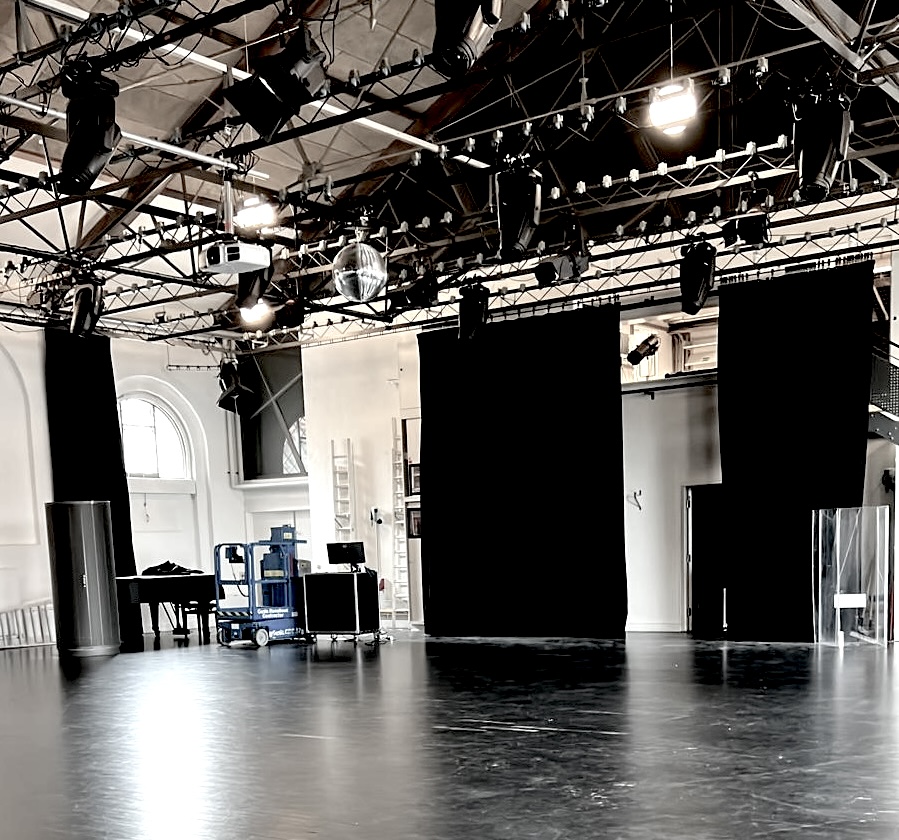
Photo: Store Sal (Large Hall) at Aarhus University’s Dramaturgy Department.

