



I approach Ngũgĩ wa Thiong’o and Naquib al-Attas here in a modest and personal way: As intellectual teachers whose work has shaped how I think about decolonisation, language, and being.
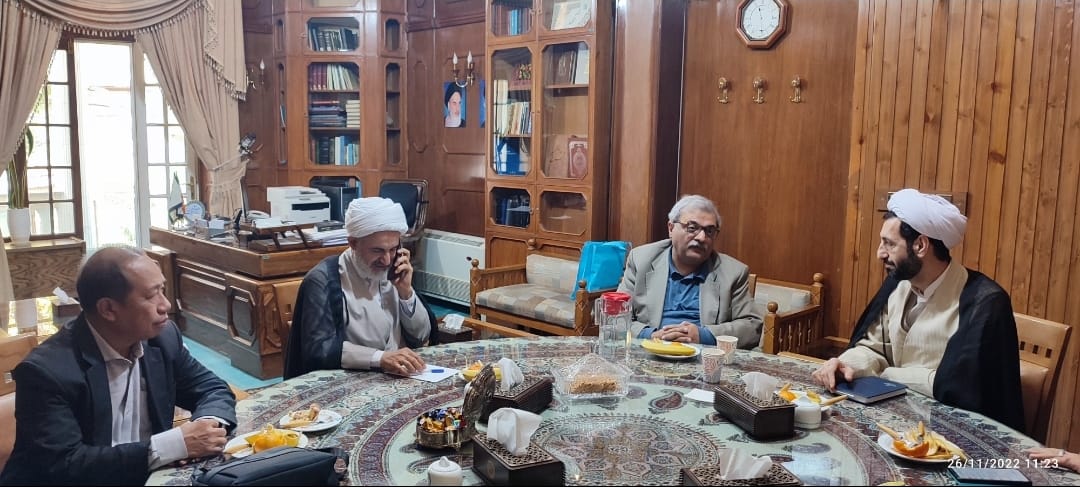
This modest and comparative approach – an attempt to think across more than one intellectual tradition in a personal yet reflective way – is grounded in a lesson I once learned from my teacher, the Indonesian Muslim philosopher Mulyadhi Kartanegara, an important yet internationally under-recognised thinker, whose work has largely been written in Indonesian. A student of the Pakistani intellectual Fazlur Rahman, and part of a wider intellectual lineage that shaped prominent Indonesian Muslim figures such as Ahmad Syafii Maarif and Nurcholish Madjid, Mulyadhi occupies a significant place within contemporary Islamic thought in Indonesia.
His pedagogical insight emerged from his own intellectual struggle. In his intellectual autobiography Menembus Batas Waktu: Panorama Filsafat Islam [Breaking the Boundaries of Time: A Panorama of Islamic Philosophy] (2002), he recounts a period of existential crisis brought about by his deep engagement with modern Western thinkers such as Marx, Nietzsche, Feuerbach, and Freud. This confrontation unsettled him profoundly, even manifesting in recurring symbolic nightmares. Yet his later immersion in the Islamic intellectual tradition – particularly through figures such as Rumi – did not lead him to reject Western thought. Instead, it allowed him to widen his horizon and to return to modern philosophy from a more critical and grounded position.
It was from this lived tension that he once said something deceptively simple, yet quietly transformative for me: If you learn only from one teacher, it becomes very difficult to criticise that teacher. But if you learn from two teachers, you gain a point of comparison. By ‘teacher’, he did not mean a person alone, but an intellectual tradition – a way of knowing, naming, and ordering the world. He was speaking about the contemporary condition of knowledge, in which one tradition, broadly Western modern scientific rationality, has come to dominate global education, scholarship, and public discourse. This dominance is not merely institutional; it is linguistic, conceptual, and affective. When we live entirely within a single tradition, our horizon of thought quietly narrows. The language, categories, and assumptions of that tradition begin to feel natural, neutral, and universal. Critique becomes difficult not because it is forbidden, but because alternatives are no longer easily imaginable.
What made this lesson compelling was that my teacher practised what he taught. He was deeply trained in Western philosophy, yet firmly rooted in the Islamic intellectual tradition. From this position, he was able to place traditions into dialogue without defensiveness, nostalgia, or subordination. Learning from more than one teacher, for him, was not an abstract commitment to ‘pluralism,’ but a lived intellectual discipline – one that required patience, humility, and sustained inhabitation of more than one world of meaning.
Over time, I have come to see this pedagogical insight as a useful way of inhabiting decolonial thought. Ngũgĩ wa Thiong’o and Naquib al-Attas can be read as thinkers who, in different ways, invite us to refuse life under a single teacher. Although they emerge from distinct historical, cultural, and intellectual contexts, both place language at the centre of their critique – not as a neutral instrument of communication, but as a condition of orientation, meaning, and existence.
Ngũgĩ’s work offers a clearer entry point into the problem of living under a single intellectual teacher. In his case, the contrast is immediately visible: A dominant Western colonial tradition on the one hand, and African linguistic and cultural worlds on the other. The opposition between these two teachers – colonial and non-colonial – is stark, making it easier to recognise how language comes to discipline thought and quietly narrows the horizon of meaning. By ‘horizon of meaning,’ I refer to the range of what a community can perceive as intelligible, valuable, or even imaginable within a given linguistic world.
I first encountered Ngũgĩ while reading postcolonial thought, particularly through an engagement with Frantz Fanon. Because both thinkers are associated with African anti-colonial struggles, Ngũgĩ’s name appeared in my readings. At the time, however, my understanding was superficial. I absorbed a simplified image of Ngũgĩ as a ‘radical’ thinker – someone who rejected English and insisted on writing in African languages. This gesture struck me as politically charged, but also excessive, even impractical.
My sustained engagement with Ngũgĩ came much later, while I was involved in translating Comparative Theories and Methods: Between Uniplexity and Multiplexity, a university textbook by Recep Şentürk and colleagues from the Istanbul Circle, an international network of scholars seeking to develop a multiplex approach to the social sciences rooted in the Islamic intellectual tradition. The Circle aims to bridge Islam and the humanities by challenging the philosophical foundations of dominant Western paradigms and proposing alternative epistemological frameworks. It was then that I began to read that Ngũgĩ’s turn to African languages was neither a symbolic provocation nor an act of cultural romanticism.
Seen through a pedagogical lens, Ngũgĩ’s project appears as an attempt to refuse confinement within a single teacher. Language, as Wittgenstein reminds us, is not merely a collection of words but a language game – a system of meaning, value, and orientation. To think and write exclusively in the colonial language is to inhabit its game fully. Over time, this shapes what feels intelligible, reasonable, and real. Colonial power, in this sense, does not need to assert itself loudly; it works quietly through linguistic habits, educational systems, and standards of legitimacy.
Ngũgĩ’s decision to write in African languages can thus be read as an effort to live inside a second teacher. By writing in Gikuyu and other African languages, he situates himself within a different system of memory, sensibility, and meaning. This does not erase colonial violence, but allows for a gradual detoxification from epistemic effects.
Ngũgĩ’s work also sustains the life of this second teacher. Each text written, read, and performed in African languages strengthens their capacity to carry thought, imagination, and critique. Decolonisation, here, is not a singular rupture but an ongoing practice of inhabiting another linguistic world. In different registers, Frantz Fanon in The Wretched of the Earth (1963) described decolonisation as the creation of a ‘new human being,’ a transformation that cannot occur overnight, while Walter Mignolo in The Darker side of Western Modernity (2011) has spoken of ‘delinking’ from colonial logics as a sustained intellectual labour rather than a single historical event. As Mamta Rani observes in her reading of Decolonizing the Mind (2022), Ngũgĩ’s linguistic turn represents a reclaiming of cultural autonomy through language.
The case of Syed Muhammad Naquib al-Attas, however, presents a more complex and internally layered problem. I first encountered al-Attas shortly after entering university where a senior student asked me, ‘What do you think is the greatest problem facing Muslims today?’ As a first-year student, I responded hesitantly, listing familiar issues: Economics, technology, politics. He replied, ‘According to al-Attas, the greatest problem is the problem of adab.’ Al-Attas himself states that ‘the loss of adab’ is the fundamental problem confronting the Muslim community, a crisis that results in confusion and injustice in knowledge and in social order. In works such as Risalah untuk Kaum Muslimin [An Epistle to the Muslims] (2001) and Islam and Secularism (1993), he argues that this loss reflects a deeper epistemological and metaphysical dislocation.
At the time, I struggled to understand this claim. The concept of adab, as I had encountered it, had already undergone significant reduction. In everyday usage, it often refers to manners or etiquette, or associated with ethics or moral conduct. In the Indonesian context, shaped by pesantren traditions, adab is frequently emphasised as character formation, captured in the slogan ‘adab before knowledge.’ This emphasis is not without merit, particularly when read against the longer trajectory of modern education.
For a long time, contemporary schooling and university systems have prioritised technical competence, efficiency, and measurable skills, often at the expense of moral formation and existential orientation. Only in more recent years has there been a growing concern with what is now widely discussed as character education, accompanied by a surge of critical reflections on what some have described as the phenomenon of the ‘university without a soul’. In this sense, the pesantren’s insistence on adab appears less as an anachronism and more as an early, if limited, response to a crisis that modern education itself took decades to recognise.
Yet this understanding barely touches what al-Attas means by adab. Through my teacher (Mulyadhi), I came to realise that the Islamic intellectual tradition is not confined to what are often called the religious sciences. It also encompasses rational sciences – both theoretical (metaphysics, mathematics, physics) and practical (ethics, economy, politics) – embedded within a coherent metaphysical worldview. Without learning from more than one educational teacher, whether modern secular schooling or traditional religious instruction, al-Attas’s thesis risks being misunderstood as ‘naïve’ moralism rather than philosophical guidance towards a coming together of the so-called Western neoliberalism and Islamic worldviews.
For al-Attas, adab is a fundamentally metaphysical concept. It refers to the recognition and acknowledgment, gradually instilled within the human being, of the proper place of everything in the order of creation. To be properly formed in adab is to act justly; to lack adab is to commit injustice. Justice and injustice here are not merely social categories, but ontological ones – they reflect whether reality is being properly understood and inhabited.
In al-Attas’s framework, language functions not only as a dwelling or a medium of expression but as a map and a compass. Through the language of an intellectual tradition, human beings learn where things belong, including themselves.
One way to grasp what al-Attas means by this loss of adab is through how we understand the human being itself. When the human is understood merely as a physical body – while the soul is denied, marginalised, or reduced to an epiphenomenon of the brain, as some strands of contemporary neuroscience suggest – then the spiritual needs of human beings are inevitably neglected. Yet if the human being is indeed composed of both body and soul, as the Islamic intellectual tradition insists, the neglect of either dimension constitutes a form of injustice toward the self.
Today, we witness extraordinary advances in physical medicine, while forms of spiritual or existential healing remain marginal, if not absent altogether. Only recently, as existential crises have become increasingly acute – often named through terms such as burnout, anxiety, or loss of meaning – have shelves of self-help literature begun to appear. This proliferation is itself a quiet recognition that the human being has spiritual needs that cannot be addressed through physical or technical solutions alone. In this sense, the damage to the linguistic and conceptual map al-Attas describes does not remain abstract; it manifests directly in how we care for, understand, and inhabit ourselves.
The problem, al-Attas argues, is that this map has been severely distorted by secularisation, a process inseparable from colonial domination. Key terms were detached from their metaphysical grounding and redefined within a secular framework. As a result, in many contemporary Muslim contexts – including my own experience – adab has been narrowed to outward behaviour or moral discipline, severed from its ontological depth. The Islamic intellectual tradition remains present in form, but impoverished in meaning.
Here, the parallel with Ngũgĩ becomes visible. In both cases, the loss or corruption of language is not merely a cultural issue, but an existential one. When a community is forced to navigate the world using a borrowed or distorted map and compass, disorientation is inevitable. It is therefore unsurprising that Fanon diagnosed colonialism not only as political domination but as a source of psychological disturbance. To live entirely within another’s language – or within a hollowed version of one’s own – is to risk losing one’s sense of self..
I believe what unites Ngũgĩ and al-Attas is not a shared ideology, but a shared intuition: Decolonisation must be understood as ontological work. It is not enough to criticise dominant systems from within their own language games. Decolonisation requires the recovery and inhabitation of another teacher – another linguistic and conceptual world capable of naming reality differently.
Neither thinker advocates withdrawal from global engagement. Ngũgĩ continues to address international audiences through translation of his works. Al-Attas, too, was deeply conversant with Western philosophy and articulated much of his critique using the English language itself. Indeed, two of his major works – Islam and Secularism and Prolegomena to the Metaphysics of Islam – were written in English. What both thinkers resist, then, is not engagement with dominant languages or traditions, but their monopolisation of meaning and authority.
Learning from ‘two teachers’ Ngũgĩ and al-Attas through the pedagogical insight of ‘third teacher’ Mulyadhi Kartanegara clarifies that decoloniality is not only a matter of resistance, but of orientation. It is about learning to live with more than one teacher so that critique becomes possible, horizons expand, and being itself can be recentred. To learn from two teachers is not to stand above them, but to allow oneself to be transformed by the tension between them.
Perhaps this is the quiet challenge they leave us with today: Not simply to oppose colonial languages or recover forgotten concepts, but to ask whether we are willing to dwell seriously within other linguistic worlds – long enough for them to teach us how to see, judge, and exist otherwise.
Photo: Mulyadhi Kartanegara at the Iranian Society of Philosophy in Tehran (from Mulyadhi’s personal collection).
